Visual Communication

With the Bachelor of Arts in Visual Communication you are able to give ideas a visual impact, from creative concept to analog and digital realization.

By working on projects throughout the programme, you will combine theory and practice while learning from the expertise of an international faculty. You will develop a broad overview of the field and deepen your individual strength, profiting from state of the art workshops with your own work stations. You can complete the degree in 3 years full-time in Bern, or in 4 years with an additional internship and a semester abroad.

Former students talk about the range of their activities, from the Typo-Club to creating animations and text design.

Begin your studies in autumn 2027.

Factsheet

  • Title/Degree Bachelor of Arts in Visual Communication
  • Specialisations in the second year:
    – Publishing
    – Campaigns
    – Design Fiction
    – Post Digital Design
  • Mode of study Full-time, 3 years (6 semesters in Bern)
    Full-time, 4 years (8 semesters, including 2 semesters abroad)
  • Start date 20 September 2027
  • Application deadline 1 March 2027
  • ECTS credits 180 ECTS-Credits
  • Teaching language German / English
  • Location Bern
  • School Bern Academy of the Arts
  • Next info event 25 November 2026

Focus Areas

In the Bachelor of Arts in Visual Communication you develop methods for presenting information effectively and creating impact through design. You will explore a wide variety of design languages and strategies and learn about the history of visual communication as well as the key principles underlying both analog and digital media.

How You Will Benefit From This Degree

In the Bachelor in Visual Communication you will learn to analyse situations, make decisions, formulate ideas and develop visual languages. You will develop the skills to implement your ideas effectively, with both digital and analog tools and formats. You move fluently between concept and design: reflecting, experimenting and adapting your solutions. By the end of your studies, you will be able to move confidently between theory and practice. You will also profit from developing your personal portfolio and an inital professional network.

View diploma pieces by our graduates – your own work could be among them in the future:

Specialisations

The degree in visual communication offers you freedom to choose your own path[KW1] . The second year will introduce you to four specialisations: Publishing, Campaigns, Design Fiction and Post Digital Design. You will explore each of these through practical approaches and targeted application as well as experimentation and research.

Projects + Social Media

Study in a Workshop-Atmosphere

The Visual Communication (Viskom) programme in Bern is a unique combination of artistic experimentation, conceptual work and technical practice.

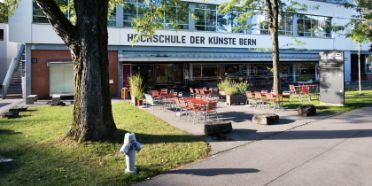
At our campus – located in a former textile factory – you study in a workshop-like environment, which encourages lively exchange. We provide a print workshop, media library and a media lab on site.

Your advantage: Throughout the entire programme, you have your own individual workspace.

Partners + Exchange

The HKB fosters a network of relationships with other universities, both in Switzerland and abroad. It collaborates with domestic and international partners on various projects. The HKB is also a member of several national and international organisations and networks.

Combining Theory and Practice in Research Projects

We foster close links between teaching, practice and research. You will gain experience with research projects even while studying for your BA.

Career Prospects

The Bachelor of Arts in Visual Communication unlocks wide range of career choices. You will be qualified to design visual concepts, develop digital products, support team communication or bring your own projects to life.

Ready for a challenge?

You will be qualified to start your own graphic design studio or creative agency. You can also work in a wide range of creative fields, including advertising, branding, PR, or marketing. You may also find exciting opportunities in publishing, museums, cultural institutions as well as associations or foundations. Our graduates work in the following fields:

  • graphic design
  • editorial design
  • illustration
  • brand design
  • typography

Further Study Options

The degree of Bachelor in Visual Communication qualifies you to pursue a Master's degree and further develop your skills. We are happy to advise you on choosing an MA programme.

The following Master's programmes are suitable for graduates of the Bachelor of Arts Visual Communication:

Duration + Content

The Bachelor of Arts in Visual Communication is a full-time programme. You can complete it in 6 or 8 semesters. The language of instruction is German. Individual mentoring can take place in other languages – usually English.

Full-time Study

You will be studying full time. We recommend limiting work outside your studies to a maximum of 8 hours per week, to ensure you have enough time for studying, lectures, projects and exam preparation.

Study Plan

Each year has a focus: Past, Present, Practice and Future. In the three-year version of the programme, you complete your internship in the summer recess. You complete your BA thesis at the end of your 6th semester.

If you chose the four-year version, you will have more time to devote to practice. In the third year you will complete an internship spend a semester abroad. The fourth year is dedicated to your BA thesis.

Modules and Courses

The programme unfolds over a maximum of 4 years.

The ‘past’ year explores the foundations of visual communication in intense study blocks:

  • Type: History, design, applications and impact
  • Image: Methods of image production, including the uses of artificial intelligence
  • Time: Dynamics of text and image in analog and digital form
  • Space: Information space, digital space, physical space
  • History and theory of visual communication

In the ‘present’ year you will engage with 4 compulsory specializations/ focus topics for half a semester each and is examined indepth through work on a project.

  • Publishing: concept, design and realization of a complex editorial project.
  • Campaign: you will develop strategies to effectively communicate issues to the public and society.
  • Design fiction: using design to develop new ideas and stories and to make potential future scenarios tangible.
  • Post Digital Design: approaching design with purely digital means, including artificial intelligence and creative coing.

From the second year onwards you will be allocated a set number mentoring hours. You can use these to seek support from lecturers in the programme, for example for your portfolio, presentations or your own projects.

Many students chose the 4-year programme. It includes a practice year between the foundational courses and your BA thesis, during which you will gain practical experience. It consists of two parts:

  • One semester internship in the field of graphic design
  • One semester studying at a partner institution in Swizerland or abroad (Erasmus programme)

In your final year, you will focus almost exclusively on your Bachelor thesis.

It includes:

  • Survivial skills: life plans, business models, career trajectories
  • Pre-project: proposal for your Bachelor thesis
  • Personal portfolio
  • Bachelor thesis

Admission Requirements

The number of places is limited (numerus clausus). We assess your suitability for the programme with an entrance examination. During the admissions process, we evaluate your artistic abilities based on your previous work and a practical examination.

Academic Requirements

You will be admitted to the programme with:

  • an upper secondary qualification
  • a specialized baccalaureate in art and design
  • a federal vocational baccalaureate
  • a gymnasial baccalaureate

You don't have a vocational qualification in the field of art and design?

Prepare by completing the preparatory course or a creative internship in the field of graphic design.

Supplementary Information on Admission

Find out which languages and prior knowledge are required before starting your studies, what the admission requirements are for international applicants, and how students are selected.

  • concept and design skills
  • technical skills
  • digital media proficiency
  • reflection and communication skills
  • Dieser Bachelor wird in Deutsch unterrichtet.
  • Zudem sollten Sie passive Sprachkenntnisse in Englisch und Französisch mitbringen (Textverständnis). Während des Studiums werden Sie diese Sprachkenntnisse aktivieren und vertiefen.

International applicants will require authentic and valid identification recognized by Switzerland; a visa may often be required. Successful international applicants must apply for a residence permit, and submit proof of sufficient funds. Prior to starting their studies, they will be required to obtain health insurance cover. Applicants should make sure they are fully informed about and compliant with their specific entry requirements for Switzerland.

Suitability Assessment

You submit a portfolio of your own work that demonstrates your creative skills and abilities (see online application below). Based on the portfolio, a jury consisting of the programme director and lecturers assesses your potential for studying on the programme and selects the applicants who are invited to complete an at-home assignment and to attend an interview. The 20-minute interview focuses on both the portfolio and the completed assignment.

Legal Disclaimer

We are unable to correspond or provide information by telephone regarding the entry assessment. The HKB accepts no liability for portfolios submitted.

Application

So, you have decided to study at the Bern Academy of the Arts?
Then do not hesitate and apply right now!

Application Deadlines

Application deadline: 1 March 2027
Aptitude assessment: March 2027
Start date: 20 September 2027

Begin your studies in autumn 2027.

Application Type

You can only apply for your studies online.

Application Documents

Please submit the following documents in electronic format (passport photo: JPG, other documents: PDF).

  • ID or passport
  • Passport photo according to international passport requirements (JPG)
  • Diplomas and leaving certificates (e.g. vocational baccalaureate/specialised baccalaureate with grades, university entrance qualification, Abitur or upper secondary level qualification)
  • Curriculum vitae in tabular form
  • A personal statement about your motivation for these studies and for your professional aspirations
  • Copies of all relevant certificates
  • Employer references (internship certificates)
  • Language certificates (if available)

For International Students, in Addition

  • Residence permit (if available)

If You Were Already Matriculated at Another University

  • Confirmation of termination of matriculation
  • Transcript of records of current and/or terminated studies

If you do not yet have one or more of the required documents, please state why in the Comments section.

Transgender Identities

Would you prefer us to address you differently to the details recorded in your official documents?

Please register the first name you go by and your gender (if binary) at the application stage, to ensure that we address you correctly during the application process. The relevant form is available on the BFH website. Please upload the completed form together with your application.

The costs for the study program consist of registration, tuition and examination fees as well as contributions for teaching materials and excursions.

  per AS 2026/27

Application (per application) and aptitude assessment*

CHF 250

Matriculation**

CHF 100

Tuition fees (per semester)

CHF 850

 
Tuition fees for international students (per semester)
Reasons for residence other than study when starting studies BFH CHF 850
Transitional arrangements for students who started their studies at BFH before autumn 2026 (until change of degree programme) CHF 1,050
Stay for study purposes at the start of studies at BFH (payment in instalments available) CHF 2,550
 

Examination fee (per semester)

CHF 80

Fee for social, cultural and sport offerings (per semester)

CHF 24

Membership fee for the Bern University of Applied Sciences Student Association (VSBFH) (per semester)

CHF 15

Leave of absence fee (per semester)

CHF 100

* The application fee can be paid by credit card or by deposit slip / paper invoice (+ CHF 10 processing fee). There are no waivers or refunds for withdrawn or abandoned applications. The application is processed after payment has been received.
** If the application leads to matriculation, the matriculation fee is covered by the application fee.

There is also a fixed fee for materials whose amount depends on the degree programme as well as additional costs for teaching materials, specialist literature, supplies, etc.


If you have any questions regarding scholarships and loans please contact the Secretariat HKB Design and Fine Arts.

Advice + Information

Do you have questions about studying? At our information events, the programme director, lecturers and students will answer your questions.

Advice

Choosing a degree programme is an important decision. We will be happy to arrange a face-to-face chat to answer your questions and advise you on the requirements for your chosen programme.

The Bern University of Applied Sciences offers students a wide range of opportunities at its locations in Bern, Biel, Burgdorf and Basel to make life attractive and enjoyable during their studies.

Information Event

At our information events, you can find out everything you need to know about the degree programme, admission requirements and your career prospects. Our students talk about their experiences on the programme and give you a personal insight into their everyday life at the Academy of the Arts HKB.

Location + Facilities

Facilities

The workshop promotes the sensitisation of the perception of materials and their processing according to creative-artistic aspects. The team conducts learning opportunities and accompanies projects by students and lecturers. Assistance and support in the realisation of works and ideas as well as advice on the purchase of materials are offered. A professional and generous infrastructure including wood, metal, plastics, ceramics and textiles is available. The range is supplemented by the material pool, an extensive collection of samples of various materials and processing methods.

The MediaLab is the competence centre of the HKB for audiovisual design and photography. Its staff hold courses, offer photography and AV training and advise students and lecturers at the HKB on content and technical issues. The workplaces and studios are equipped with an extensive production infrastructure and are available around the clock. Students at the HKB have the opportunity to use equipment outside of the MediaLab for the implementation and presentation of audiovisual and photographic projects.

In the printing studio you will find the HKB expertise for manual printing techniques. Its staff not only offer various courses in screen printing, gravure printing and letterpress printing, but also support students in their projects, if required. After attending an introductory course and after consultation with the responsible lecturers, students can also work independently in the printing studio outside opening hours.

The Media Library is the library of the departments of Design and Art, Conservation and Restoration, the Y Institute (Institute for Transdisciplinarity) and Research. It is open to members of the HKB as well as external users. 35,000 media are directly available in the open access library, including approximately 300 periodicals. As a member of the NEBIS network (Network of Libraries and Information Centres in Switzerland), it provides access to more than seven million titles in more than 300 libraries. These titles can be accessed online.